


Load King Equipment Guide at CTOS
Many fleet managers are familiar with Load King trailers, but the brand now covers a broader equipment lineup. Load King manufactures boom trucks, tracked aerial devices and purpose-built service bodies alongside the heavy haul trailers that built the brand’s reputation.
Choosing the right Load King equipment starts with understanding how its trailer and vocational lines serve different jobsite needs.
What Does Load King Make?
Load King manufactures two primary product families. Its trailers move heavy equipment and materials between jobsites, while its vocational equipment handles lifting, service and access needs once crews arrive. Fleets may rely on both types, and both options come from the same Load King manufacturing operation.
Load King expanded that footprint through the Terex product line acquisition, which added boom truck, crossover and truck crane production to its established trailer business. This shift reflects the manufacturing industry’s move toward vertically integrated brands that design, build and service their own lineups.
The right product family depends on the job. Some fleets need equipment for transport, while others need equipment for lifting, service or jobsite access. Choosing between boom trucks and cranes versus a hauling trailer starts with answering that question.
Inside the Load King Trailer Lineup
Load King trailers are built for specific hauling applications, from heavy equipment transport to utility and materials hauling:
- Signature Series Hydraulic Detachable Goosenecks (HDG): Load King’s flagship heavy haul trailer drops its hydraulic detachable neck to the ground, creating a self-contained ramp for tracked and wheeled equipment. The Signature Series comes in 55-, 60- and 65-ton configurations. In 2018, Construction Equipment Magazine recognized the Signature Series 60-Ton Lowboy Trailer on its 100 New Products Award list. Common applications include road and bridge work, heavy hauling, utility work, pipeline projects and oil field operations.
- Folding gooseneck trailers: Load King introduced the original E-Z Fold mechanical folding gooseneck in 1966, earning Patent of the Year for the design. Folding goosenecks remain useful for heavy-duty industrial applications. They simplify loading and unloading while giving crews a ground-bearing design built for demanding haul cycles.
- Tag trailers: Load King’s tag and tag-and-tilt trailers, including the LK-20-T, use 6-inch crossmembers and spring-assisted ramps that ease lifting during loading and unloading. They fit fleets that need a practical way to move smaller machines, attachments or jobsite equipment without stepping into a heavier trailer class.
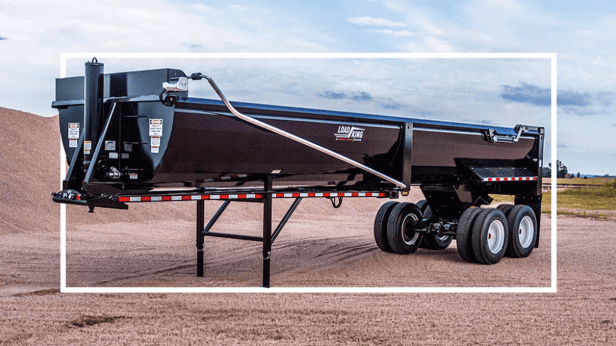
- Side and bottom dump trailers: Load King’s side dump runs a 50-degree dump angle, which supports faster cycles and a cleaner tub. Its low center of gravity fits roadway, rail and other large-project applications. Bottom dump configurations, including the LK-2060-40-2 and LK-2060-40-3, serve stockpiling, material transport and asphalt paving applications.
- Reel and pole trailers: Pole trailers adjust in length between the front dolly and rear axles. Some models offer telescopic extenders for poles, pipe and lumber. Reel trailers, including the LK-910RT-SL, are built around the weight distribution needs of cable reels used in utility work. Sourcing Load King trailers and parts from one manufacturer also simplifies spec standardization across mixed trailer fleets.
Inside the Load King Vocational Equipment Lineup
Although trailers remain central to Load King’s reputation, the vocational lineup expands the brand’s role beyond hauling. Each line fits a different field application, from highway-mobile lifting to utility access and on-site repair:

- Stinger boom truck series: Highway-mobile telescopic boom truck cranes range from the 35-ton Stinger 35-127RS to the 80-ton Stinger 80-160. The 80-ton model’s six-section, full-power double-keel boom reaches 170 feet at maximum tip height, or 228 feet with the optional bifold jib. Highway-speed mobility lets one crane cover multiple jobsites in a day. That mobility is especially useful for contractors, utilities and service teams that schedule shorter lifts across multiple locations.
- Outback tracked aerial devices: Built for reaching areas that wheels can’t, the Outback’s tracked undercarriage handles soft ground and narrow terrain across utility easements. The Outback 35-53B delivers 53 feet of working height, 30 feet of side reach and a 500-pound platform. It runs on a 25-horsepower Tier 4 Kubota diesel and is rated to ANSI Category C at 46kV for live-line utility work. The newer Outback 28SC-30 runs on a full lithium battery electric PTO, delivering quiet operation with an ultra-narrow profile and a compact outrigger footprint to maneuver through confined spaces.
- Voyager® AMX+ service trucks: Load King’s Voyager® AMX+ field service unit pairs a corrosion-resistant aluminum service body with an integrated 12,000-pound-capacity crane and 30-foot reach. It combines lifting, storage and an air and power system on one chassis. Available in a 14-foot configuration, its aluminum construction improves payload efficiency over steel service bodies. For field service teams, that combination can reduce the need to send separate lifting, storage and power resources to the same jobsite.
How to Choose the Right Load King Equipment for Your Application
Once fleet managers understand the two product families, the next step is matching equipment specs to the work. Selecting a trailer starts with considering hauling requirements, route conditions and loading method. Meanwhile, vocational equipment selection should factor in lift capacity, reach, terrain and how often crews need to move between jobsites.
Trailer selection variables include:
- Load weight and type: Match the trailer’s rated capacity to the actual weight of the tracked equipment, wheeled equipment or bulk material being hauled.
- Loading method: Choose a drive-on, winch-on or gravity-dump trailer based on the equipment type and site conditions.
- Deck height and permits: Review height constraints, legal limits and oversize or overweight permit requirements before planning the route. Lower deck heights can create more room for taller machines, while permit requirements may influence the trailer style, route and hauling timeline.
Vocational equipment variables include:
- Load weight and reach: Match crane capacity to the load’s weight, lift height and distance from the crane’s center of rotation.
- Site access and mobility: Choose equipment based on terrain, access points and whether the unit needs highway-speed mobility.
Fleet managers who need both product families and ready access to replacement parts benefit from a manufacturer-direct source where specs, parts and service connect back to the same equipment lineup. Lift planning tools can refine capacity decisions before a unit leaves the yard.
Fleet standardization also matters after the purchase. When trailers, service bodies, cranes and replacement parts connect back to the same manufacturer-direct source, teams can make more accurate spec decisions, coordinate service more efficiently and keep equipment planning tied to the actual work crews perform.
Get Your Load King Equipment Through Custom Truck One Source
Custom Truck One Source manufactures and sells Load King equipment, giving buyers direct access to the engineering and parts knowledge behind every unit. We back Load King fleets with more than 35 service locations and a 24/7 call center. Fleets can work with us for new sales, rental or lease options, parts, service and asset disposal. We keep trailers and vocational equipment moving under one roof.
Contact us to discuss your application with a product specialist.

Ready to keep your fleet moving?
Talk to a Custom Truck One Source specialist about equipment, parts, and service options built around your fleet.
Request a QuoteOr call (844) 822-5581