


11 Common Questions About the IRS Section 179 2018 Deductions
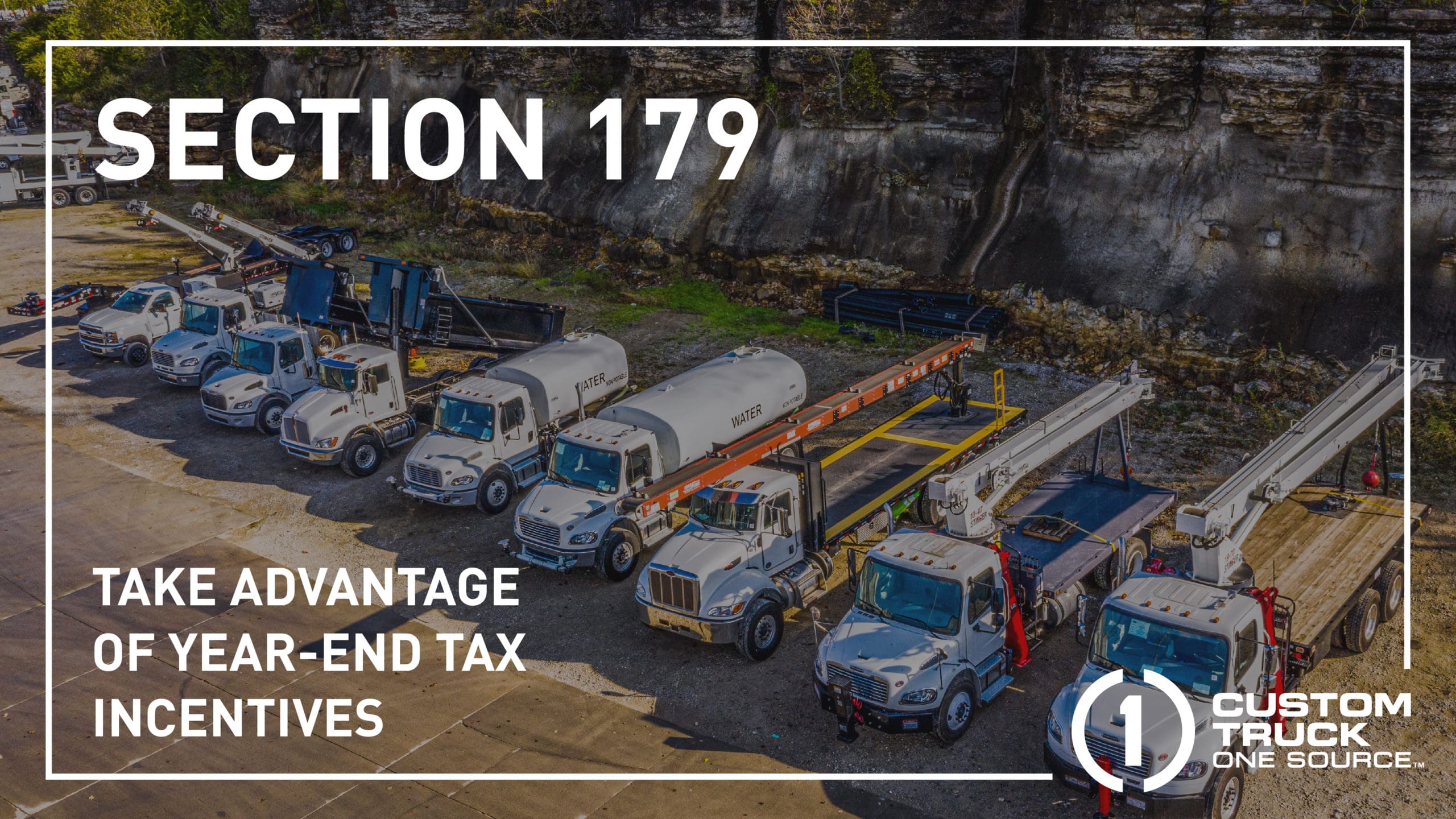
As 2018 draws to a close, specialized truck buyers are rushing to take advantage of the IRS Section 179 deduction. If the acquisition of trucking equipment is important to grow and run your own business, then you should be similarly excited about Section 179 and take action as soon as possible.
The Tax Cuts and Jobs Act (TCJA) expanded Section 179 expensing, increasing the maximum amount that can be expensed to $1 million and broadening the list of qualifying property.
The new and improved clauses in Section 179 makes 2018 an incredible year to save on taxes.
, we are receiving a lot of queries from potential buyers of specialized trucks – dump trucks, boom trucks, forestry trucks, building supply trucks, diggers, trailers etc. – about how they can take advantage of Section 179 before December 31st, 2018.
In this article, we’re answering 11 most common questions customer ask us about Section 179. And while this is by no means legal advice on how you can use Section 179 to improve your business, we are the first single-source provider of specialized trucks and heavy equipment solutions in North America and have the largest rental line-up in the nation.
If you have any questions about purchases or leases before December 31st, 2018, do call us at 844-282-1838 or Email us at: [email protected]. Please contact us for more information or assistance regarding Section 179 deductions. We’re standing by to help you get the most value from Section 179 deductions. We have the largest selection of equipment to suit every budget.
#1: Why is the IRS Section 179 Deduction Such an Exciting Proposition In 2018?
- The $500,000 limit of 2017 has extended to $1,000,000 in 2018. This means small businesses and small business owners can deduct the entire cost of qualifying equipment purchased or financed during the tax year. Generally, if you buy or lease qualifying equipment, you can deduct the entire cost from your gross income. This is a rare benefit that the U.S. government is offering to encourage small and medium-sized businesses to look forward, buy equipment, and do a faster and quicker job of scaling their operations for their future.
#2: Has the Bonus Depreciation Also Been Raised?
Yes. The bonus depreciation has also increased to 100% through 2022. It covered only ‘new’ equipment until the most recent tax laws passed. Fortunately, recently ‘used’ equipment is also included. The bonus depreciation applies to property placed in service during the tax year. The deduction amount depends on the property being placed in service within the applicable calendar year, as different calendar years may have different depreciation rates or limits.
Bonus Depreciation is useful to very large businesses spending more than the Section 179 Spending Cap (currently $2,500,000) on new capital equipment.
#3: What About the Phase-Out Purchase Limit?
From $2,030,000 in 2017, the phase-out limit has increased to $2,500,000. This phase-out limitation is subject to an annual inflation adjustment, and these dollar amounts are adjusted each year through inflation adjustments. These changes affect the deduction limits for different tax years, specifically for tax years beginning after 2017, ensuring that the limits reflect current economic conditions. This means your deductions will start to decrease dollar-for-dollar only after you have exceeded this new limitation for the applicable tax year.
For example, if you purchased equipment with a cost of $4 million, you would now be $1,500,000 over the phase-out purchase limitation, and your deduction would decrease by $1,500,000.
#4: What is the Big Advantage Of Section 179?
Businesses can make an election under Section 179 to expense certain property, providing flexibility in tax planning. The rules specify that only property which qualifies—such as improvements to nonresidential real property—can be expensed. Qualified real property includes improvements like qualified improvement property, which covers buildings, heating, air conditioning, air conditioning property, security systems, and alarm systems. Section 179 allows businesses to treat these improvements as expenses for tax purposes, rather than capitalizing and depreciating them over time. These provisions are relevant across various industry sectors, and the Section 179 election can also impact the availability of certain tax credits. The deduction is taken in the year of the transaction when the property is placed in service. It lets business-owners choose between individual assets compared to bonus depreciation. This also allows for a 100% write-off, but has to be elected for an entire class of assets.
#5: What is the Disadvantage Of Section 179?
You can only use it if the taxpayer has taxable income for the year. Taxpayers are not exempt from the requirement to have taxable income in order to use the Section 179 deduction.
#6: Where Can We Find A Section 179 Calculator?
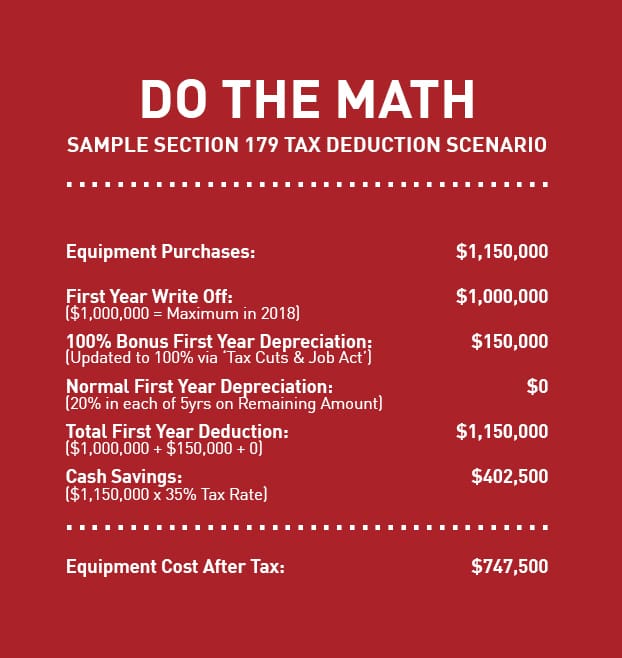
Here’s an updated example of Section 179 at work during the 2018 taxable year. (Source: Section179.org) The Section 179 calculator also offers valuable insights into how the deduction works for different scenarios.
#7: Are Specialized Trucks An Eligible Deduction?
Absolutely! Which is why we’re urging buyers to act before December 31, 2018. Specialized trucks are considered tangible property and are qualified property under Section 179, allowing businesses to expense them. Take advantage of the deductions on new, used and leased specialized trucks and heavy equipment from Custom Trucks One Source. (Check out our inventory by clicking here.)
#8: How Can Section 179 Be Combined With Equipment Financing?
This is a very important conversation to have with your financial lender. Businesses can elect to expense certain qualified depreciable business assets under Section 179. Different entities, such as corporations or partnerships, can benefit from Section 179 expensing. Payments made on leased or financed equipment do not disqualify it from Section 179 eligibility, as long as the equipment is in service and used for business purposes. According to Justin Forbrook, Vice President at U.S. Bank: “The amount you deduct will almost always exceed your cash outlay for the year when you combine (i) a properly structured Equipment Lease or Equipment Finance Agreement with (ii) a full Section 179 deduction. It is a bottom line enhancing tool (plus, you get the new equipment you’re adding to your business).”
#9: What Is Section 179 Depreciation Recapture?
If you sell an asset after taking depreciation on it, the sale is treated as income for tax purposes. You have to declare the amount you sold it for as “income” to “recapture” the income on the depreciation you have just taken. In certain cases, adjustments related to depreciation recapture may result in a tax refund if you have overpaid taxes due to previous deductions.
#10: What Is A Section 179 Carryover?
In case you have taken a Section 179 deduction in excess of your taxable income, you can carry that amount over to the next year. Carryover amounts are subject to specific rules and limitations under Section 179. If a taxpayer elects to take a Section 179 deduction in excess of their taxable income, they can carry over the amount to the next year. For example: You take $50,000 of Section 179, but only have $20,000 of taxable income before the deduction. The $30,000 carries forward to the next tax year.
#11: What Is Section 179 Amended Return?
Corporations and other entities can go back to a previous year and amend the return to change the amount taken for Section 179 deductions. Amending a return may affect the overall tax bill for the taxable year beginning in the relevant period. Property such as computer software may be included in an amended Section 179 deduction. Tax provisions under the Internal Revenue Code allow for amended returns to change the amount taken.
- This information is provided for general use only and does not constitute specific tax or legal advice on any particular matter. We expressly disclaim any liability resulting from reliance on this information. Please discuss any specific circumstances with your accounting, legal and tax advisors.
- Sources: Section179.org, DeltaModTech and HawkinsAshCPAs.

Ready to keep your fleet moving?
Talk to a Custom Truck One Source specialist about equipment, parts, and service options built around your fleet.
Request a QuoteOr call (844) 822-5581