


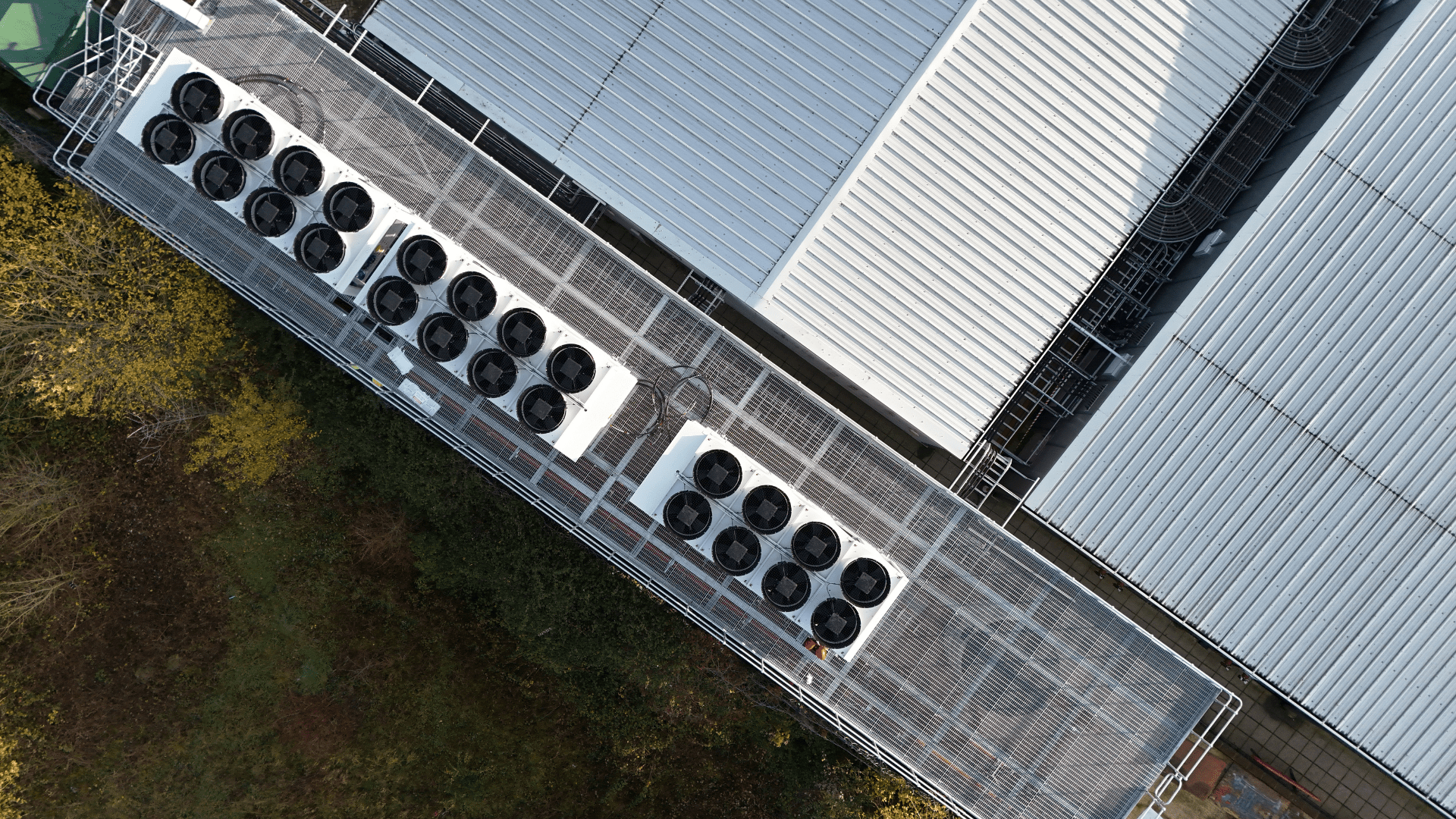
The Data Center Boom Is Reshaping the Power Grid and the Construction Markets that Support It. Custom Truck One Source is at the Forefront.
An Update on the Data Center Boom (April 2026)
Since our last post on this topic, published in May 2025, the pace and scale of U.S. data center construction has outrun early projections. Here is what has changed in the last year, what it means for construction and utility teams working in this space, and where Custom Truck One Source is positioned in the industry to participate and support the tremendous growth.
The Numbers Have Jumped Sharply
U.S. data center construction starts hit an estimated $77.7 billion in 2025, a 190% year-over-year increase, according to ConstructConnect. Monthly spending on starts climbed from around $500 million in mid-2021 to $6.5 billion in December 2025, and 2026 is tracking toward roughly $121 billion in full-year spending. The American Edge Project counts 4,149 active U.S. data centers with another 2,788 announced or under construction, a pipeline expected to generate around 4.7 million temporary construction-related jobs. The Stargate joint venture, involving OpenAI, SoftBank, Oracle, and MGX, has expanded from a $100 billion concept into a $500 billion multi-year infrastructure program targeting 10 GW of total capacity, and Anthropic has separately announced a $50 billion investment to create data centers with fellow AI startup Fluidstack, beginning in Texas and New York.
For Custom Truck One Source, these numbers are not just headlines. They represent the core of the company’s customer needs and priorities. Transmission and distribution work accounts for approximately 60% of CTOS end market exposure, and T&D capital spending is projected to reach $102 billion in 2025 alone, growing at an 8.4% CAGR through 2029, with transmission-specific spending growing at more than 15% annually. The AI-driven data center buildout is the single biggest accelerant behind that investment cycle, and CTOS is built to capture it.
The Geographic Map Has Broadened
Northern Virginia and Texas are still the largest hubs, but power constraints in established markets have pushed developers toward new regions. The Rust Belt is back in a major way - Illinois, Indiana, and Ohio collectively saw more than $22 billion of new data center starts in the first quarter of 2026, including Meta’s $10 billion, 1 GW campus in Lebanon, Ind. The Plains and Mountain West are also seeing an unusual surge, with roughly $28 billion in late-stage preconstruction projects across the Montana–Utah–Minnesota–Nebraska corridor. Other notable additions to the map include Vantage’s $15 billion campus in Port Washington, Wisconsin, xAI’s $20 billion site in Southaven, Mississippi, AVAIO’s $6 billion campus in Little Rock, Arkansas, AWS’s $10 billion campus in Richmond County, North Carolina, and Vantage’s $25 billion, 1.4 GW Frontier campus in Shackelford County, Texas.
This geographic diversification mirrors and reinforces Custom Truck’s own national expansion strategy. The company opened new branches in Portland, Oregon, and Orlando, Florida in 2025 and is actively targeting additional underserved markets, including the Pacific Northwest, Northern California, the New York and New Jersey metro area, and the Carolinas. With 41 branch locations and a fleet of approximately 10,350 units, the company is scaling its footprint to meet demand wherever it emerges, ensuring customers have access to the right equipment in the right place at the right time.
Power Is Now the Primary Constraint
A year ago, grid capacity was a consideration. Today, it is the single biggest factor determining whether and where new data center projects move forward. U.S. utilities plan to invest roughly $1.4 trillion over the next five years to update the nation’s aging power grid, according to a recent PowerLines report, with most citing data centers as a top driver of capital spending. PJM Interconnection, the largest U.S. grid operator, projects it will be a full six gigawatts short of its reliability requirements in 2027, and approximately 70% of the grid is approaching the end of its life cycle, according to Power Magazine’s 2026 industry outlook. In response, more developers are turning to behind-the-meter and on-site generation, including natural gas turbines, geothermal, microgrids, and small modular reactors, to bypass interconnection queues that can stretch for years.
This is where Custom Truck’s integrated, one-stop-shop model means that utility and construction customers do not have to piece together solutions from multiple vendors. From specialty equipment rentals to new and used equipment sales, aftermarket parts and service, and equipment financing, CTOS delivers end-to-end support across the entire project lifecycle. With an average customer tenure of more than 18 years and a diversified base of more than 8,000 customers, including blue-chip utilities and infrastructure operators, CTOS has the relationships, the reputation, and the resources to be a long-term partner through this unprecedented investment cycle.
What This Means for the Construction Market
The AGC’s 2026 industry outlook found that a net 57% of responding contractors expected data center construction spending to increase in 2026, the highest percentage by category, with power infrastructure second at a net 34%. Power infrastructure starts were also up 21% year over year in Q1 2026. For fleet planning, that translates to sustained demand on two fronts: the data center builds themselves and the substations, transmission lines, and grid upgrades required to power them.
Both sides of that work fall squarely within the equipment categories CTOS and Load King support. Boom trucks and cranes for vertical construction, digger derricks and bucket trucks for utility expansion, and dump trucks and trailers for site work are all core to the CTOS fleet. And with rental utilization reaching 83.6% in Q4 2025, the highest level in more than two years, and a Specialty Truck Equipment & Manufacturing (STEM) new vehicle order backlog of $370 million as of March 2026, the data is clear: demand is not slowing down, and CTOS is ready to meet it.
The secular tailwinds driving this market, AI infrastructure investment, grid hardening, electrification, and renewable energy integration, are not short-term phenomena. They represent a multi-year, multi-trillion-dollar transformation of the American energy infrastructure. Custom Truck One Source is built for exactly this moment, and the work is just getting started.

Ready to keep your fleet moving?
Talk to a Custom Truck One Source specialist about equipment, parts, and service options built around your fleet.
Request a QuoteOr call (844) 822-5581